
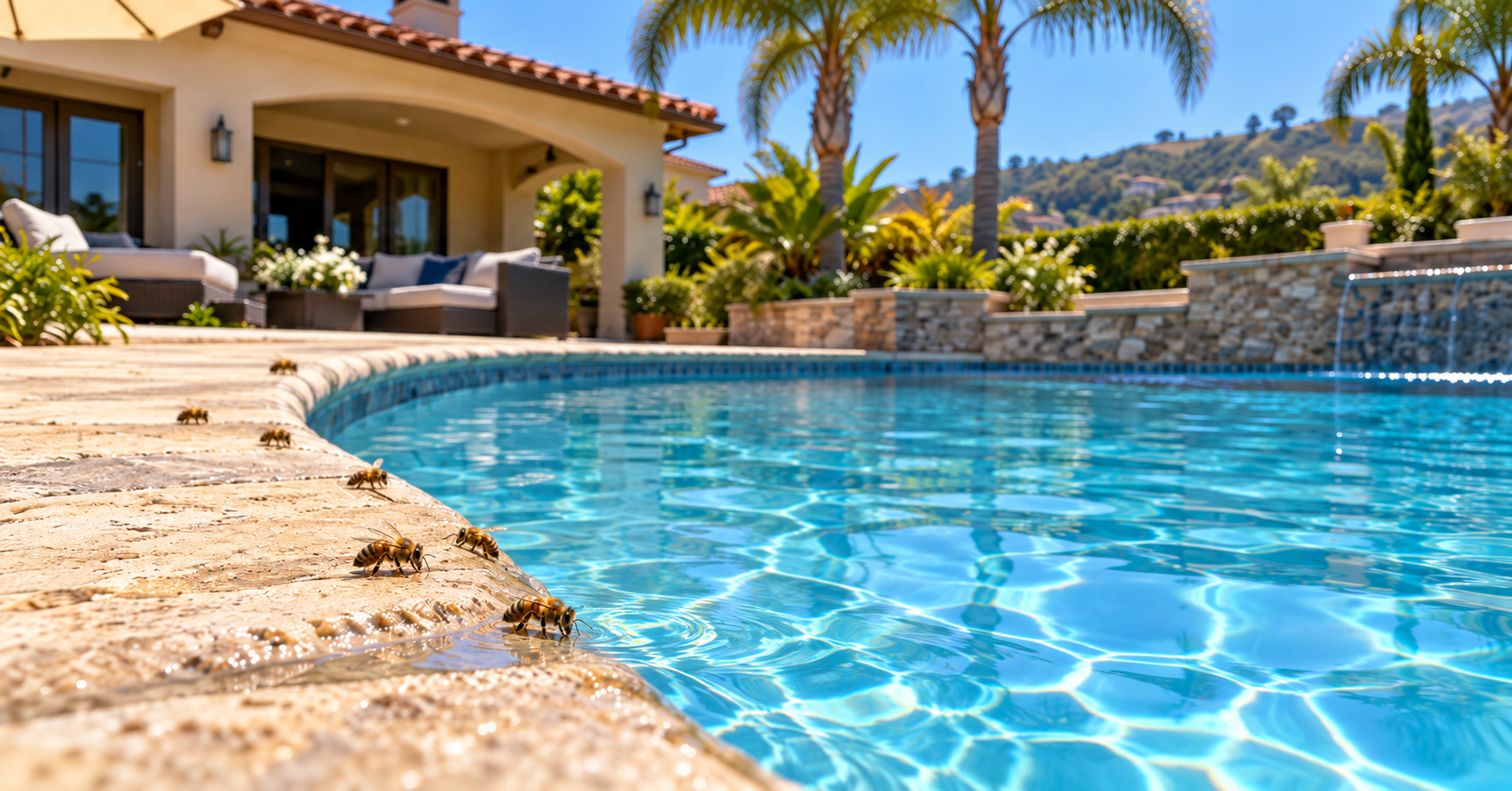
Swimming pools, fountains, spas, birdbaths, irrigation systems, and other outdoor water sources can attract bees—especially during warm, dry weather when colonies are actively searching for dependable water.
Seeing a few bees drinking from the edge of a pool does not necessarily mean there is a hive on your property. But when large numbers of bees return to the same water source every day, follow the same flight path, or disappear into a nearby roof, wall, utility box, or landscape area, there may be a colony established close by.
The Bee Man provides professional bee control around swimming pools, fountains, and outdoor water sources for homeowners and properties in the Orange County communities we serve.
If bees are making it difficult to safely use your pool, patio, yard, or outdoor living area, call The Bee Man at (949) 455-0123.
Why Are Bees Coming to My Swimming Pool?
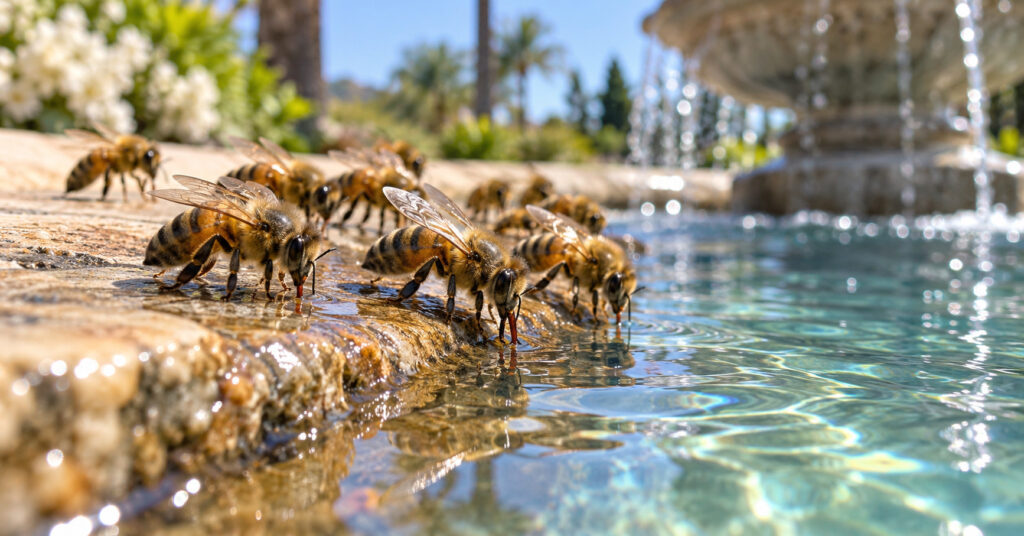
Honeybees need water just like other animals.
A residential swimming pool can become an attractive water source because it offers a large, consistent supply. Bees may land along the coping, steps, spillways, wet concrete, pool equipment, or other areas where they can safely access moisture.
Other outdoor water sources that may attract bees include:
- Fountains
- Spas and hot tubs
- Birdbaths
- Pet water bowls
- Irrigation systems
- Dripping faucets
- Condensation lines
- Pond edges
- Water features
- Wet landscaping
- Leaking pool equipment
A few visiting bees may simply be collecting water.
The concern increases when dozens of bees repeatedly arrive from the same direction throughout the day.
Does Bee Activity Around a Pool Mean There Is a Hive Nearby?
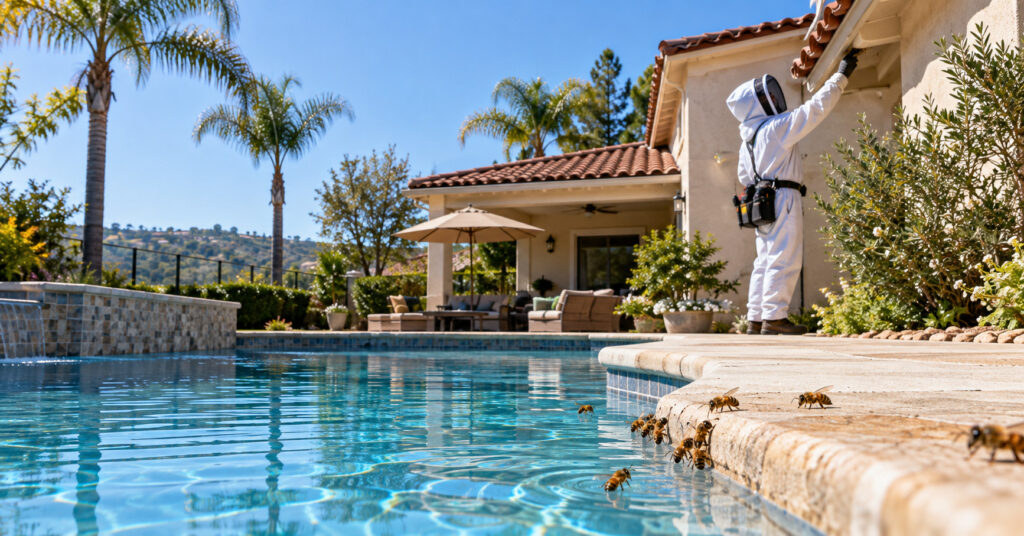
Not always.
Bees can travel considerable distances while foraging for food and water, so the colony may not be directly beside your swimming pool.
However, repeated activity can provide clues.
If you watch the bees carefully, you may notice that many of them leave the water source in approximately the same direction.
That flight pattern can sometimes help identify the general area where the colony is located.
The hive could be inside or around:
- A roof or eave
- A stucco wall
- A soffit
- An attic
- A utility enclosure
- A meter box
- A tree
- A shed
- A landscape feature
- Another nearby structure
If bees repeatedly disappear into part of your home, professional inspection may be appropriate.
For structural activity, see our page about bee removal from walls in Orange County.
Why Do Bees Keep Coming Back to the Same Pool?
Once worker bees discover a reliable water source, they may continue returning to it.
That is why homeowners sometimes notice bee activity at approximately the same time each day or see bees repeatedly landing along the same section of pool coping.
Simply removing individual bees from the pool does not address the colony supplying them.
If the colony remains active nearby, other workers can continue visiting the water source.
This is also why bee activity around a pool can seem to disappear briefly and then return.
When Does Poolside Bee Activity Become a Problem?
A few bees drinking quietly from the far side of a pool may not require immediate removal.
The situation becomes more concerning when bee activity begins interfering with how people use the property.
You may want the area evaluated when:
- Large numbers of bees gather around the pool
- Bees repeatedly land near swimmers
- Children or pets cannot safely use the yard
- Bees gather around a spa or patio seating area
- People with known sting allergies use the property
- Bees follow a consistent route toward the house
- Bees are entering a roof, wall, or utility area
- A swarm suddenly appears nearby
- Defensive behavior develops around a particular location
A professional evaluation can help determine whether you are dealing with water-foraging bees or a nearby established colony.
Bees Around Pools and Outdoor Entertaining Areas
Pools are often located beside some of the most frequently used areas of a home.
That may include:
- Patios
- Outdoor kitchens
- Barbecue areas
- Children’s play areas
- Pool decks
- Lounge areas
- Cabana spaces
- Outdoor dining areas
When heavy bee activity overlaps with these spaces, the issue can quickly become more than an inconvenience.
People may begin swatting at bees, children may panic, and pets may investigate insects near the water.
Avoid disturbing or striking bees whenever possible.
If the number of bees is increasing, determining where they are coming from is more useful than repeatedly trying to eliminate individual bees around the pool.
What About Bees Around Fountains and Water Features?
Decorative fountains and landscape water features can also become regular bee watering locations.
Bees may land around:
- Fountain edges
- Rocks
- Shallow basins
- Overflow areas
- Wet concrete
- Moss-covered surfaces
- Splash zones
Because fountains often provide shallow access to water, bees may find them easier to use than deeper pools.
Again, the presence of a few bees does not automatically indicate an infestation.
Repeated high-volume traffic may justify looking for the source.
Bees Around Pool Equipment and Plumbing
Sometimes the activity that appears to be related to the pool is actually connected to the equipment surrounding it.
Bees may investigate openings around:
- Pool equipment enclosures
- Pipes
- Conduit
- Electrical penetrations
- Equipment sheds
- Pump areas
- Utility boxes
- Wall openings
A small gap around a pipe or conduit can potentially lead into a protected cavity.
If bees are entering and leaving one of these openings rather than simply drinking water, there may be a structural colony.
Do Not Seal an Opening If Bees Are Going Inside
If you discover bees entering a wall, roof, pool equipment enclosure, or utility opening, do not immediately seal it.
If an active colony is inside, blocking the exterior entrance can trap bees within the structure.
They may then search for another route out.
Depending on the construction, that could potentially lead them toward an attic, wall cavity, ceiling, garage, or occupied portion of the home.
The active colony should be addressed before the opening is permanently excluded.
Our bee-proofing services for Orange County homes page explains why removal and exclusion should be handled in the correct order.
What If the Bees Are Coming From the Roof?
Tile roofs, soffits, fascia, and eaves can provide protected spaces for colonies.
This is especially important around homes where a swimming pool is positioned close to the house.
Homeowners may see bees drinking from the pool and then flying directly toward one section of the roof.
The roof can look perfectly normal from the outside while bees are entering through a relatively small gap.
For more information, read our guide to bee removal from attics, eaves, and roof tiles in Orange County.
You can also read this OC Helper article about why bees can get into tile roofs even when the roof looks fine from the outside.
What If Bees Are Coming From Inside a Wall?
Poolside bee traffic sometimes leads homeowners to discover a completely different problem.
For example, bees may collect water at the pool and then return to a small opening in a stucco wall.
The visible entrance may only be the access point. The actual hive may be farther inside the wall cavity.
An established colony can potentially leave behind honeycomb, wax, honey, pollen, propolis, and other hive material.
If structural cleanup is needed after removal, learn more about honeycomb removal and structural cleanup in Orange County.
Can I Keep Bees Away From My Pool Without Removing Them?
When bees are only collecting water and there is no colony on the property, completely eliminating visits may not be realistic.
Some homeowners try to reduce attractive water conditions by fixing leaks, eliminating unnecessary standing water, and maintaining outdoor plumbing.
However, if a nearby colony has already established the pool as a dependable water source, worker bees may continue returning.
The more important question is whether the bees are simply visiting or whether the water activity is helping reveal a hive nearby.
That distinction determines whether professional removal is actually necessary.
What Should I Do While Waiting for Bee Control?
If bee activity around the pool is heavy:
- Keep children and pets away from concentrated activity
- Avoid swatting at bees
- Do not spray large numbers of bees around the pool
- Do not attempt to open roofs, walls, or utility boxes
- Do not seal an entrance if bees are actively using it
- Observe where bees go when they leave the water
- Note whether activity increases at particular times of day
This information can help during an inspection.
If someone is experiencing a severe allergic reaction or other medical emergency following a sting, seek appropriate emergency medical assistance.
Bee Control Around Pools at HOAs and Managed Properties
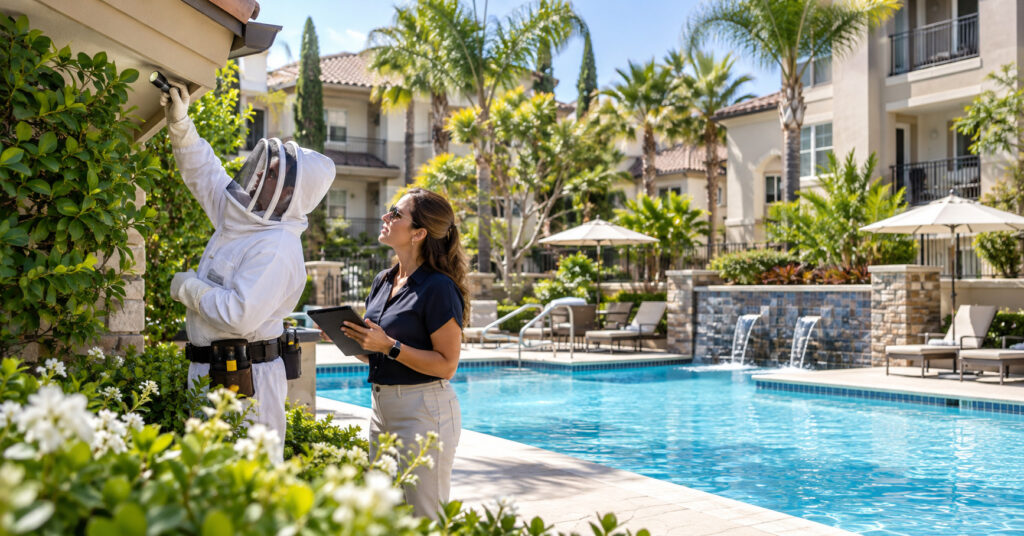
Pool-related bee problems are not limited to single-family homes.
They can also affect:
- HOA pools
- Condominium communities
- Apartment complexes
- Community recreation areas
- Hotels
- Country clubs
- Schools
- Commercial courtyards
- Shared fountains and water features
These locations can present added concerns because large numbers of residents, visitors, employees, or children may use the same outdoor area.
A recurring bee problem around a shared pool should be evaluated to determine whether there is a colony somewhere on the property.
For managed and commercial locations, see our commercial bee, wasp, and yellow jacket removal in Orange County service page.
Why Removing the Hive Can Matter More Than Treating the Pool
When the real source of the problem is an established colony, focusing only on the bees drinking from the water does not address the cause.
The correct approach may involve:
- Identifying where the bees are coming from
- Determining whether a colony is established
- Addressing the active hive
- Evaluating whether honeycomb or hive material remains
- Repairing or excluding the original entry point when appropriate
That sequence addresses the underlying problem rather than only the visible activity around the swimming pool.
Professional Bee Control Around Outdoor Water Sources
The Bee Man has served Southern Orange County communities since 1977, helping homeowners and property managers deal with bees, beehives, wasps, and yellow jackets around homes and businesses.
If bees are gathering around your swimming pool, fountain, spa, or other outdoor water source, the first step is determining whether they are simply visiting for water or whether there is an active hive nearby.
For professional bee control in the Orange County communities we serve, call The Bee Man at (949) 455-0123.