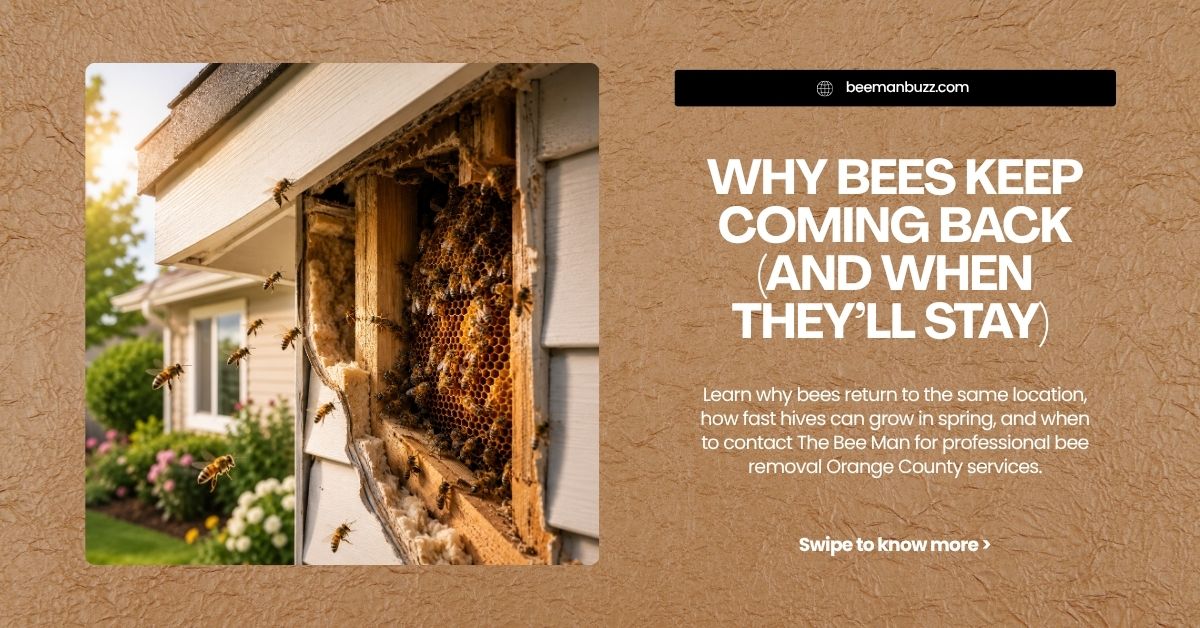
Why Bees Keep Coming Back (And When They’ll Stay)
Spring in Orange County brings a surge in bee activity—and for many homeowners, that shows up as bees repeatedly circling the same spot on the house.
At first, it looks random. It isn’t.
When bees return to the same location, follow the same paths, and increase in number over time, it’s usually the early stage of something more permanent. Understanding why they’re there and how quickly things can change is what separates a minor issue from a major one.
What Attracts Bees to Your Home?
Bees are not wandering—they are evaluating.
Scout bees are constantly searching for locations that meet very specific conditions for a hive. Homes often provide exactly what they need.
What They’re Actually Looking For
- Stable internal temperature (walls and attics regulate heat well)
- Protection from wind and predators
- Small, defensible entry points
- Proximity to food and water sources
Even a small gap along a roofline or vent can check every box.
Why Homes Are Ideal
Wall cavities, soffits, and attics act like natural hive spaces:
- Enclosed
- Dry
- Insulated
- Difficult for predators to access
Once a scout bee finds a location like this, it doesn’t just leave—it returns repeatedly and begins signaling to other bees.
This is the stage most homeowners overlook.
Do Bees Leave on Their Own?
This depends entirely on what stage you’re catching them in.
Early Stage (Possible Departure)
If bees are:
- Visiting flowers
- Passing through the area
- Not focused on one entry point
They may leave.
Scouting or Settling Stage (Unlikely to Leave)
If you’re seeing:
- Repeated visits to the same exact spot
- Bees entering and exiting a gap
- Increasing activity each day
They are no longer “visiting”—they are deciding.
Once that decision is made and a swarm moves in, the colony becomes established quickly. At that point, they are not going anywhere without removal.
For a deeper breakdown of how quickly that decision turns into a problem, see: How Fast Should You Act When You See Bees Moving In? (And Are Bees Protected by Law?)
Do Bees Remember Locations?
Yes—and this is one of the biggest reasons problems escalate.
Bees use spatial memory and environmental mapping to:
- Return to productive locations
- Maintain consistent flight paths
- Communicate those locations to the colony
Once a spot is identified as suitable:
- It becomes part of their navigation system
- Other bees are directed there
- Activity becomes predictable and repeatable
This is why homeowners often notice:
- Bees arriving at the same time each day
- Bees flying identical routes
- Activity concentrated in one exact location
That consistency is a signal—not coincidence.
How Fast Can a Bee Hive Grow in Spring?
Faster than most people expect—and faster than most homeowners react.
What Actually Happens Over Time
Days 1–3:
Scout bees inspect the area repeatedly
Days 4–10:
A swarm may arrive and begin occupying the space
Weeks 2–4:
Comb construction begins and expands
Egg-laying starts
1–2 Months:
Population increases significantly
Honey storage builds
2–3 Months:
A fully established hive develops
Internal buildup begins affecting the structure
Why Spring Accelerates Growth
- Warmer temperatures
- Longer daylight hours
- Abundant food sources
These conditions allow colonies to grow rapidly, which means delays have consequences.
Why Timing Matters More Than You Think
Each of these factors compounds:
- A location attracts scout bees
- Scout bees return and recruit others
- The colony settles
- Growth begins immediately
By the time activity becomes obvious, the process is already well underway.
That’s why early recognition matters more than reaction.
If activity is consistent, it’s worth addressing before it turns into structural damage. Professional bee and wasp removal at the right time prevents much larger issues later.
Quick Answers Homeowners Are Searching For
Why do bees keep coming back to my house?
They’ve identified your home as a potentially suitable nesting location and are evaluating or preparing to occupy it. Repeated visits to the same spot are rarely random.
Will bees leave on their own?
Only if they are still scouting and have not started building a hive. Once a colony becomes established, they are unlikely to leave without professional removal or relocation.
How long do bees remember locations?
Bees have excellent spatial memory and can remember productive food sources and suitable nesting locations. They may continue returning as long as the location remains attractive.
How fast can a hive grow?
During spring and early summer, a colony can begin forming within days and expand significantly within weeks as comb is built, brood develops, and honey is stored.
Why are bees only coming during the afternoon?
Bees are most active during warm, sunny parts of the day when temperatures are ideal for scouting and foraging. Consistent afternoon activity in the same location may indicate they are evaluating your home.
Why do only a few bees come at first?
Scout bees investigate potential nesting sites before a swarm arrives. It is common to see only a handful of bees initially, with activity increasing over several days if the location is approved.
Why do bees keep flying around my roofline?
Rooflines, soffits, vents, and eaves often provide sheltered openings that bees view as excellent nesting locations. Repeated activity in these areas should not be ignored.
Can bees return to the same house every year?
Yes. If a location remains attractive or still contains old wax, hive scent, or suitable entry points, scout bees may rediscover and evaluate it again during future swarm seasons.
Why are bees hovering but not entering my house?
They may still be inspecting the location. Scout bees often circle openings multiple times before determining whether the space is suitable for a colony.
Why do bees disappear at night?
Honeybees generally return to the hive before dark and are far less active overnight. Activity typically resumes after temperatures rise the following morning.
Can rain make bees leave?
Rain may temporarily reduce bee activity because bees avoid flying in poor weather, but it does not cause an established colony to abandon a suitable nesting site.
Why do bees suddenly appear after warm weather?
Warm temperatures trigger increased foraging and swarm activity. Spring and early summer are the busiest seasons for scout bees searching for new nesting locations.
Should I seal the hole if only a few bees are visiting?
No. If scout bees are evaluating the location or a colony is already inside, sealing the entry can trap bees within the structure and make removal more difficult.
How can I tell the difference between scouting bees and an established hive?
Scout activity usually involves a small number of bees inspecting an area. Constant traffic with bees entering and exiting the same opening throughout the day often indicates an established colony.
Can bees find the same entry point again after leaving?
Yes. Bees use landmarks, sunlight, and spatial memory to relocate familiar entrances. If conditions remain favorable, they may repeatedly return to the same gap or opening.
How many days should I wait before calling a professional?
If bees continue returning to the same location for several consecutive days, or if activity steadily increases, it is best to have the situation evaluated before a colony becomes established and the problem becomes more complicated.
Final Takeaway: Repetition Means Something Is Developing
Bees don’t return to the same spot without a reason.
- Repetition means evaluation
- Consistency means commitment
- Growth means time is limited
If you’re seeing these patterns around your home, you’re likely looking at the early stages of a hive—not random activity.
Contact The Bee Man for expert bee removal Orange County and safe, professional solutions that protect both your home and the bees.
Related Homeowner Guides
If you’re seeing repeated bee activity around your home, these guides provide additional insights into what you may be observing and why acting early matters:
- Why Bees Follow the Same Flight Path Every Day – Learn how bees use memory, landmarks, and navigation to return to the same locations repeatedly.
- Bees Inside Your Walls? Signs, Risks, and What Happens If You Wait Too Long – Understand the warning signs of a colony establishing itself inside your home’s structure and the risks of delaying action.
- Why DIY Bee Removal Often Fails (And Why Sealing Bees Inside Makes It Worse) – Discover why sealing entry points or attempting DIY removal can create larger structural and bee management problems.
- How Fast Should You Act When You See Bees Moving In? (And Are Bees Protected by Law?) – Learn when a few scout bees can quickly become a full colony and why timing is critical.